
Can Solar Panels Power an Entire Home? Here's What You Need to Know

Many homeowners considering solar energy have one important question:
Can solar panels power my entire home?
The short answer is: Yes, a properly designed solar power system can generate a significant portion, or in suitable setups potentially all, of a home's electricity needs.
However, the answer depends on several factors, including your household electricity consumption, rooftop space, sunlight availability, solar system capacity, battery requirements, and the type of solar system you choose.
Before installing solar panels, it is important to understand how the system works and how much energy your home actually needs.
How Do Solar Panels Power a Home?
Solar panels convert sunlight into electrical energy.
During the daytime, the panels generate electricity from sunlight. This electricity can then be used to operate household appliances such as:
Lights
Fans
Refrigerators
Televisions
Washing machines
Computers
Air conditioners
Water pumps
Other electrical appliances
The electricity generated by the panels passes through an inverter, which converts it into usable electricity for your home.
Depending on the type of solar system, excess electricity may be sent to the grid or stored in batteries for later use.
Can Solar Panels Run All Your Home Appliances?
There is no single solar capacity that works for every home.
The required capacity depends on your average electricity consumption.
A homeowner should review previous electricity bills and determine the approximate number of units consumed each month.
For example, if your electricity consumption is consistently higher, you may require a larger solar installation.
Other factors such as sunlight availability, rooftop space, panel efficiency, system losses, and future electricity requirements should also be considered.
A professional solar installer can assess these factors and recommend a suitable system size.
What Happens at Night?
One common question homeowners have is:
If solar panels need sunlight, how will my home get electricity at night?”
Solar panels do not generate electricity after sunset.
There are two common ways a solar-powered home can handle nighttime electricity requirements.
1. Grid-Connected Solar
With a grid-connected system, the home can use solar electricity during the day and remain connected to the electricity grid.
Depending on the applicable system and local regulations, excess solar generation may be exported to the grid, while electricity can be drawn from the grid when required.
2. Battery Storage
A solar system can also be designed with battery storage.
During the day, solar energy can be used by the home, while excess generation can be stored in the battery.
The stored energy can then be used when solar generation is unavailable.
The right configuration depends on your electricity requirements and backup expectations.
Can Solar Panels Work During Cloudy Weather?
Solar panels do not stop working simply because the sky is cloudy.
They can still generate electricity from available daylight, although their output can be lower compared with bright, direct sunlight.
The actual energy generation depends on factors such as:
Cloud cover
Sunlight intensity
Panel orientation
Shading
Panel quality
System design
Weather conditions
This is one reason why solar systems are generally designed based on expected energy generation over time rather than relying on a single day's output.
What About Air Conditioners?
Air conditioners can consume a significant amount of electricity compared with many other household appliances.
If your home uses one or more air conditioners regularly, this should be considered when determining the required solar capacity.
For example, a household that uses air conditioning for several hours every day may need a larger system than a similar-sized home with minimal AC usage.
Your solar installer should consider your actual appliance usage when designing the system.
Does Roof Size Matter?
Yes.
Solar panels require sufficient usable rooftop space.
The available area can affect:
Number of panels that can be installed
Total system capacity
Panel arrangement
Panel orientation
Shading conditions
Maintenance access
A professional site assessment can help determine whether your roof is suitable for the required solar capacity.
Can Solar Panels Reduce Your Electricity Bill to Zero?
Solar energy can significantly reduce electricity costs, but a zero electricity bill should not be assumed for every home.
Your actual electricity bill depends on:
Solar system size
Electricity consumption
Solar generation
Grid usage
Applicable electricity regulations
Export/import arrangements
Fixed charges and other applicable charges
The best approach is to evaluate your historical electricity usage and estimate the expected solar generation before installation.
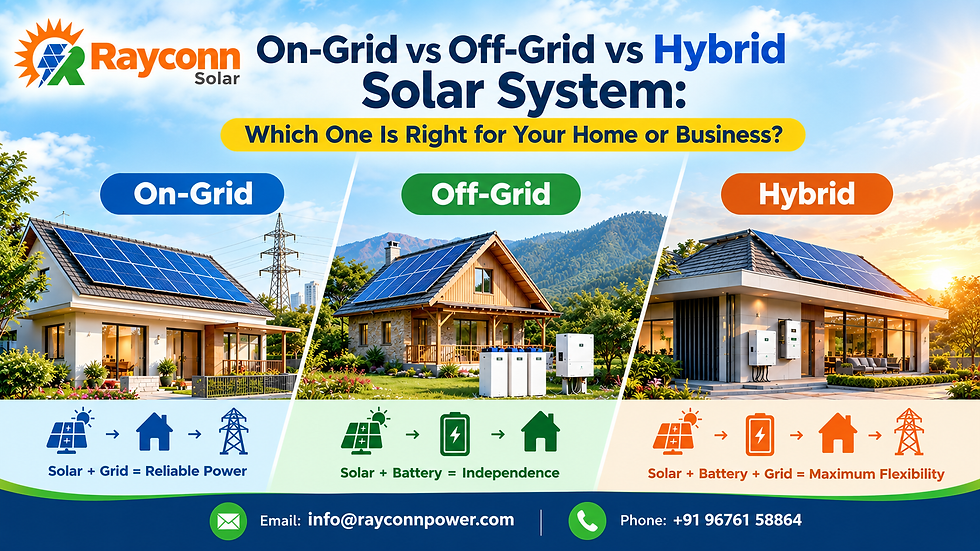
What Is the Difference Between On-Grid, Off-Grid and Hybrid Solar?
Choosing the right system type is important if your goal is to power your home with solar energy.
On-Grid Solar
An on-grid system is connected to the electricity grid.
It can be suitable for homes that want to generate solar electricity while remaining connected to the grid.
Off-Grid Solar
An off-grid system operates independently from the electricity grid and generally uses batteries to store energy for periods when solar generation is unavailable.
Hybrid Solar
A hybrid system combines solar generation, battery storage, and grid connectivity depending on the system design.
The most suitable option depends on your home's electricity usage, backup requirements, budget, and local conditions.
What Size Solar System Is Right for Your Home?
Instead of selecting a system based only on your home's size, consider your actual electricity consumption.
Before installation, check:
1. Monthly electricity unitsReview your recent electricity bills.
2. Major appliancesList appliances that consume significant electricity.
3. Daily usageConsider how many hours your appliances operate.
4. Rooftop spaceCheck how much usable, relatively unshaded space is available.
5. Future requirementsConsider whether you may add an AC, EV charger, water heater, or other appliances.
6. Backup requirementsDecide whether you need battery backup during power interruptions.
These factors help create a more realistic solar system design.
Why Professional Solar Installation Matters
Solar panels are a long-term investment. The quality of the installation can influence system performance, safety, and maintenance.
A professional solar company can help with:
Site assessment
Energy consumption analysis
System sizing
Panel selection
Inverter selection
Installation
Electrical connections
System testing
Maintenance guidance
Choosing a system based only on the lowest installation price may not provide the complete value you need over the long term.
Can a Solar System Be Expanded Later?
In some situations, homeowners may want to increase their solar capacity in the future.
For example, electricity consumption may increase after installing:
An electric vehicle
Additional air conditioners
A larger refrigerator
Electric water heating
Additional home appliances
However, whether a system can be expanded depends on the inverter, available roof space, electrical configuration, and other technical factors.
Therefore, discussing future requirements during the initial design stage can be helpful.
Why Choose Rayconn Power for Residential Solar?
Rayconn Power Solutions provides solar energy solutions for residential and other applications.
For homeowners considering rooftop solar, the company can help assess energy requirements, available rooftop space, and suitable solar system configurations
A properly planned residential solar system can help households make greater use of renewable energy while reducing dependence on conventional electricity.
Final Thoughts
So, can solar panels power an entire home?
Yes, a properly designed solar system can meet a home's electricity requirements to a significant extent, and suitable systems can be designed around very high levels of solar usage.
However, the required system depends on your electricity consumption, appliances, rooftop space, sunlight availability, system type, and whether battery backup is required.
Before installing solar panels, review your electricity bills, understand your household's energy requirements, assess your roof, and consult a professional solar installer.
The right solar system is not necessarily the biggest one. It is the one properly designed around your home's actual energy needs.


Comments