
On-Grid vs Off-Grid vs Hybrid Solar System: Which One Is Right for Your Home or Business?
Solar energy has become a practical option for homeowners and businesses looking to generate electricity from renewable energy. However, choosing solar panels is only one part of the process.
One of the most important decisions is choosing the right type of solar system.
The three commonly discussed options are On-Grid, Off-Grid, and Hybrid Solar Systems. Each system works differently and offers different benefits depending on your electricity usage, location, power requirements, and need for backup.
Understanding these differences can help you choose a solar solution that matches your requirements.
What Is an On-Grid Solar System?
An On-Grid Solar System, also called a grid-connected solar system, is connected to the local electricity grid.
During the day, solar panels generate electricity from sunlight. The electricity can be used by the home or business, while excess generation may be exported to the grid according to applicable electricity regulations and metering arrangements.
When the solar system is not generating enough electricity, such as at night, electricity can be drawn from the grid.
How Does an On-Grid System Work?
The basic process is:
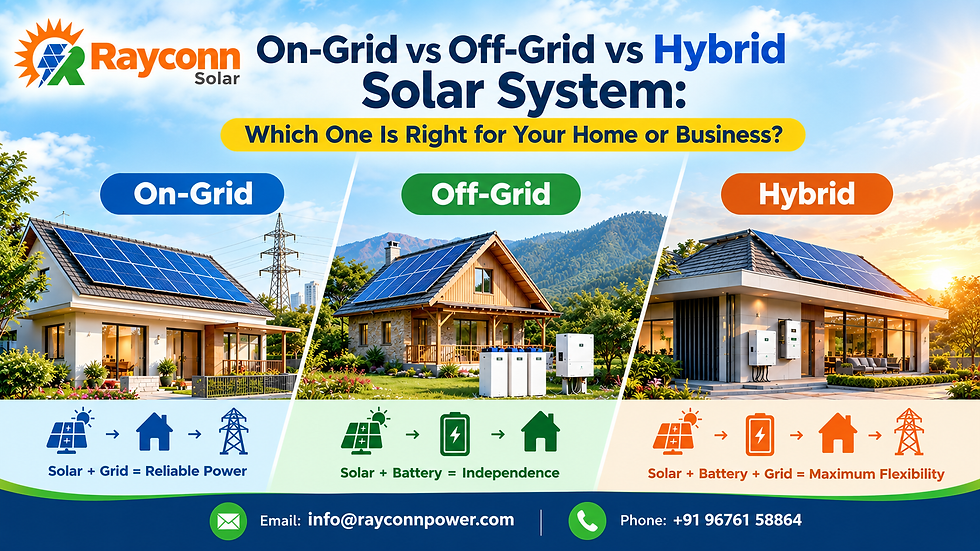
Solar Panels → Inverter → Home/Business → Electricity Grid
The solar panels generate DC electricity, and the inverter converts it into AC electricity that can be used by electrical appliances.
Advantages of On-Grid Solar
Works with the existing electricity grid
Generally does not require a battery
Can reduce electricity purchased from the grid
Suitable for homes and businesses with regular grid availability
Can make use of excess solar generation through applicable grid arrangements
What Is the Limitation?
A standard on-grid system generally does not provide backup power during a grid outage because the system is designed to disconnect from the grid for safety.
Therefore, if backup during power cuts is an important requirement, another configuration may be more suitable.
What Is an Off-Grid Solar System?
An Off-Grid Solar System operates independently of the electricity grid.
It typically uses solar panels together with batteries to store electricity generated during the day.
The stored energy can then be used when solar generation is low or unavailable.
How Does an Off-Grid System Work?
A simplified setup is:
Solar Panels → Charge Controller/Inverter → Battery → Electrical Loads
During daylight hours, the solar panels generate electricity. Some of the energy can be used immediately, while excess energy can be stored in batteries.
At night or during periods of low sunlight, the stored energy can supply the connected loads.
Advantages of Off-Grid Solar
Can operate independently of the grid
Provides energy storage through batteries
Useful in locations with limited or unreliable grid access
Can provide power when grid electricity is unavailable
What Should You Consider?
Battery capacity becomes particularly important in an off-grid system.
The system needs to be designed according to electricity consumption, expected backup requirements, solar generation and battery storage capacity.
What Is a Hybrid Solar System?
A Hybrid Solar System combines solar generation, battery storage, and grid connectivity.
This configuration can provide greater flexibility because the system can use solar power, store energy in batteries, and interact with the electricity grid depending on the system design and operating conditions.
A simplified setup can be represented as:
Solar Panels + Battery + Grid → Inverter → Electrical Loads
During the day, solar energy can power appliances and charge the battery. Depending on the system configuration, stored energy can be used when solar generation is insufficient.
Advantages of Hybrid Solar
Combines solar generation and battery storage
Can provide backup capability
Can reduce dependence on grid electricity
Offers flexibility in managing energy usage
Suitable for users who want both solar savings and backup functionality
However, hybrid systems generally involve additional equipment and battery costs compared with a basic grid-connected system.
On-Grid vs Off-Grid vs Hybrid Solar
The main differences can be understood through the following comparison:
Feature | On-Grid | Off-Grid | Hybrid |
Connected to Grid | Yes | No | Yes |
Battery | Usually not required | Required | Usually included |
Backup During Grid Outage | Generally no | Yes | Yes, depending on system |
Works Independently of Grid | No | Yes | Partially |
Battery Cost | Lower | Higher | Higher |
Suitable For | Homes & businesses with reliable grid access | Remote or independent power requirements | Users needing solar + storage + grid |
Excess Solar Storage | Usually no battery storage | Stored in battery | Stored in battery |
The exact system design, equipment and operating features can vary depending on the installation.
Which Solar System Is Suitable for a Home?
There is no single system that is ideal for every home.
The right option depends on factors such as:
Monthly electricity consumption
Electricity tariff
Availability of grid power
Frequency of power cuts
Backup requirements
Available rooftop space
Budget
Battery requirements
Local electricity regulations
If Your Home Has Reliable Grid Power
An on-grid system may be considered if your main goal is to generate solar electricity and reduce dependence on grid power.
If Your Home Has Frequent Power Cuts
A hybrid system may be considered when battery backup is an important requirement.
If Grid Electricity Is Not Available
An off-grid system may be considered for locations where independent power generation and storage are required.
Which Solar System Is Suitable for a Business?
Commercial and industrial electricity requirements can be significantly different from residential usage.
Businesses may operate during specific hours and have equipment that consumes considerable amounts of electricity.
Before selecting a system, businesses should evaluate:
Daytime electricity consumption
Peak power requirements
Operating hours
Electricity tariff
Available rooftop area
Backup requirements
Critical electrical loads
Battery requirements
Future energy demand
For a business that consumes most of its electricity during daylight hours, solar generation can be particularly relevant because the generated electricity can be used directly during operating hours.
Do You Need a Battery for Solar?
Not every solar installation requires a battery.
An on-grid system can operate without battery storage because the electricity grid remains connected to the system.
Batteries become more relevant when the customer wants to:
Store excess solar energy
Use solar energy later
Have backup during power interruptions
Reduce dependence on grid electricity during selected periods
Battery requirements should be calculated according to actual energy usage and backup expectations rather than choosing a battery size based only on the total solar panel capacity.
What Should You Check Before Installing Solar?
Choosing the system type is only the first step.
Before installation, consider the following:
1. Understand Your Electricity Consumption
Check your recent electricity bills and identify how much electricity your home or business actually consumes.
2. Check Your Rooftop
The available roof area, orientation, shading, structural condition and accessibility can affect system design.
3. Identify Your Backup Requirements
If you need electricity during power cuts, communicate your backup requirements before selecting the system.
4. Compare Equipment
Ask about the solar panels, inverter, mounting structure, batteries if required, protection equipment and other components included in the proposal.
5. Consider Future Electricity Needs
If your electricity consumption is expected to increase because of additional appliances, machinery or business expansion, discuss the future requirement during system planning.
6. Understand Maintenance
Solar systems generally require routine inspection and cleaning. Battery-based systems may require additional attention depending on the battery technology and installation.
Solar System Selection Should Be Based on Your Requirements
Choosing between on-grid, off-grid and hybrid solar should not be based only on the initial installation cost.
A proper decision should consider:
Electricity usage + Grid availability + Backup requirement + Roof space + Battery requirement + Budget + Future energy needs
For example, a household with reliable grid electricity and no backup requirement may have different needs from a business that requires uninterrupted power for critical equipment.
Similarly, a remote location without reliable grid connectivity may require a different approach altogether.
Why Professional Solar System Design Matters
Every building has different energy requirements.
A properly designed solar system should consider the customer's electricity consumption, site conditions, solar potential, equipment specifications, electrical requirements and applicable regulations.
Professional assessment can help determine:
Required solar capacity
Number of panels
Inverter capacity
Battery capacity, if required
Suitable mounting arrangement
Electrical protection requirements
Expected energy generation
Instead of selecting a system only by panel capacity, it is important to evaluate the complete system.
Frequently Asked Questions
1. What is the difference between on-grid and off-grid solar?
An on-grid system is connected to the electricity grid, while an off-grid system operates independently and generally uses batteries to store energy.
2. Is a battery required for an on-grid solar system?
A standard on-grid solar system does not normally require a battery. Battery storage can be added when backup or energy storage is required, depending on the system design.
3. Which solar system works during a power cut?
Off-grid systems can operate independently of the grid, while hybrid systems can provide backup through battery storage when designed for that purpose. A standard on-grid system generally shuts down during a grid outage.
4. Is hybrid solar more expensive than on-grid solar?
A hybrid system generally involves additional battery storage and associated equipment, so the initial system cost can be higher than a basic on-grid installation.
5. Can solar panels work on cloudy days?
Solar panels can still generate electricity under cloudy conditions, although their output is generally lower than under strong sunlight. Actual generation depends on weather conditions, system design and other factors.
6. Which solar system is best for a home?
The appropriate system depends on the home's electricity consumption, grid availability, backup requirements, budget, rooftop conditions and energy goals.
7. Which solar system is suitable for a business?
Businesses should consider their operating hours, daytime electricity consumption, peak loads, grid reliability, rooftop space and backup requirements before selecting a solar configuration.
Conclusion
On-grid, off-grid and hybrid solar systems each serve different energy requirements.
An on-grid system can be suitable for users who have reliable grid access and primarily want to generate solar electricity.
An off-grid system can be considered when independent electricity generation and battery storage are required.
A hybrid system combines solar generation, battery storage and grid connectivity for users who want greater flexibility and backup capability.
The right choice depends on your electricity consumption, location, grid availability, backup requirements, rooftop conditions and future energy needs.
Before installing a solar system, it is important to assess your requirements and select a system that is properly designed for your home or business.


Comments