
Solar Battery Storage : How to Choose the Right Backup for Your Home in Vizag

Solar energy is a practical way to generate electricity for your home, but what happens when the sun goes down or a power outage occurs? This is where solar battery storage can make a difference.
For homeowners in Visakhapatnam (Vizag), a solar battery can store electricity generated during the day and make it available later, depending on the system configuration. However, choosing the right battery requires more than simply selecting the largest capacity. You need to consider your household's electricity consumption, backup requirements, budget, and the type of solar system installed.
In this guide, we explain how to choose the right solar battery backup for your home in Vizag.
1. Understand How Solar Battery Storage Works
Solar panels generate electricity when sunlight is available. A battery storage system stores electrical energy for later use, such as during the evening or a power outage.
A typical solar battery system includes:
Solar panels: Generate electricity from sunlight.
Inverter: Converts electricity into the form required by your appliances and manages energy flow according to the system design.
Battery: Stores energy for later use.
Protection and control equipment: Helps the system operate safely within its designed limits.
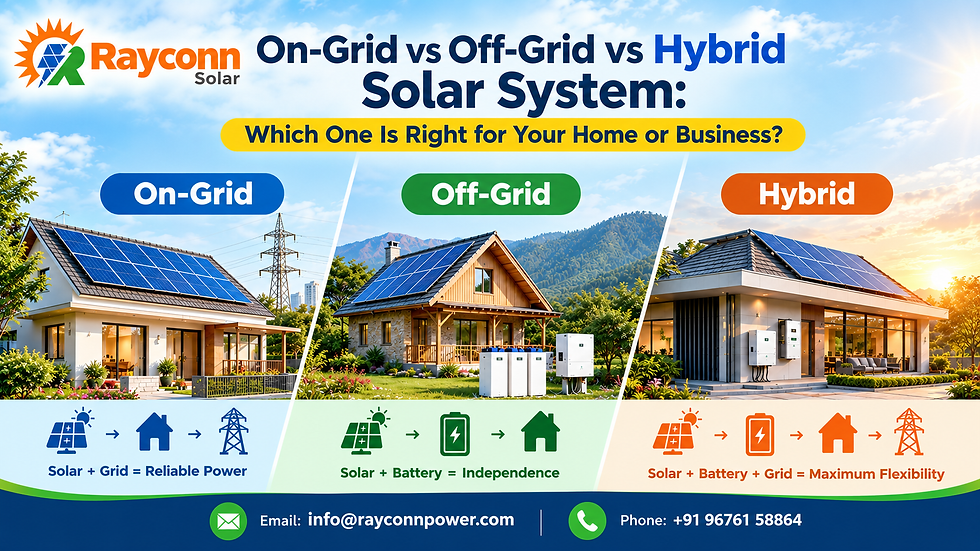
The exact configuration depends on whether you choose an off-grid, hybrid, or another compatible solar system.
An important point to remember is that a standard on-grid solar system usually shuts down during a grid outage for electrical safety. It will not automatically provide backup power unless it has compatible backup equipment and the appropriate system configuration.
2. Calculate How Much Backup Power Your Home Needs
Before choosing a battery, identify which appliances you want to operate during a power cut.
For example, you may want to keep the following running:
LED lights
Ceiling fans
Wi-Fi router
Television
Laptop or phone chargers
Refrigerator, if supported by the system
Air conditioners, water heaters, pumps, and other high-power appliances may require a much larger battery and inverter. Their starting power requirements must also be considered.
Make a list of the appliances you want to use and estimate how many hours each will operate. This will help you calculate the approximate energy required.
3. Understand Battery Capacity: kWh vs. kW
Two important terms are used when selecting a solar battery.
Battery capacity (kWh): Indicates how much energy a battery can store.
Power output (kW): Indicates how much power the battery system can deliver at a particular moment.
For example, a battery with a capacity of 5 kWh may store enough energy for several hours of selected household loads, but the actual backup time depends on appliance consumption, usable battery capacity, inverter efficiency, and operating conditions.
A battery with sufficient energy capacity may still be unsuitable if its power output is too low for the appliances you want to operate simultaneously.
Always check both the battery capacity and the compatible inverter's output rating.
4. Estimate Your Required Battery Size
You can make an initial battery estimate by calculating the energy consumed by your essential appliances.
Use this formula:
Energy required (kWh) = Appliance power (W) × Operating hours ÷ 1,000
For example, suppose your essential loads consume approximately 400 watts in total and you want to operate them for 5 hours.
400 W × 5 hours ÷ 1,000 = 2 kWh of electricity
This is the estimated energy delivered to the appliances. The battery's rated capacity will need to be higher to account for usable capacity limits and system losses.
For planning purposes, a 3 kWh battery might be considered for this example, but the final selection depends on the battery's specifications, backup power requirements, and the inverter system. A qualified installer should confirm the appropriate size.
5. Choose the Right Solar Battery Type
Different battery technologies are available for residential energy storage.
Lithium-Ion Batteries
Lithium-ion batteries, including lithium iron phosphate (LFP) models, are used in many modern energy storage systems. Depending on the product, they may offer high usable capacity, good efficiency, and a long cycle life.
Before purchasing, check the manufacturer's cycle-life conditions, warranty, operating temperature range, battery management system, and compatibility with your inverter.
Lead-Acid Batteries
Lead-acid batteries are also used in backup applications. Their suitability depends on the required backup duration, maintenance needs, usable capacity, and total cost over the expected service life.
When comparing battery options, do not look only at the initial purchase price. Consider usable energy, warranty, maintenance, replacement costs, and the manufacturer's specifications.
6. Select a Battery Compatible With Your Solar System
Not every battery works with every inverter. Compatibility is essential for safe and reliable operation.
Before buying, confirm:
Whether your inverter supports battery storage.
The battery voltage and communication compatibility.
The maximum charging and discharging power.
Whether the system supports backup operation during a grid outage.
Which household circuits will receive backup power.
Whether the required protection equipment is included.
If you already have rooftop solar panels, a professional should inspect your existing inverter and system configuration before recommending a battery retrofit.
7. Consider Vizag's Coastal Climate
Visakhapatnam's coastal environment can expose outdoor equipment to humidity, salt-laden air, and high temperatures. Battery systems and associated electrical equipment should be installed in a suitable location according to the manufacturer's environmental requirements.
Keep these points in mind:
Choose equipment rated for the intended installation environment.
Install the battery in a well-ventilated location within its specified temperature range.
Protect the system from direct rain, flooding, and excessive heat.
Ensure electrical connections and enclosures are appropriately protected.
Follow the manufacturer's requirements for clearances and maintenance.
Battery installation should always comply with applicable electrical safety standards and be carried out by qualified professionals.
8. Understand the Cost of Solar Battery Backup
The total cost of a solar battery system depends on battery capacity, battery technology, inverter compatibility, installation requirements, protection equipment, and the amount of backup power required.
A smaller system designed for lights, fans, and communication devices will generally have different requirements from one intended to run larger appliances.
When requesting a quotation, ask for:
Battery capacity and usable energy.
Continuous and peak power output.
Compatible inverter specifications.
Expected backup time for your selected loads.
Warranty and expected service life.
Installation and protection equipment costs.
Maintenance and replacement considerations.
Compare quotations using the same backup requirements so you can make a meaningful comparison.
9. Common Mistakes to Avoid
Avoid these common mistakes when choosing a solar battery:
Buying a battery based only on capacity: Check the power output as well as the stored energy.
Expecting every appliance to run during an outage: Backup depends on system capacity and which circuits are connected.
Assuming all on-grid systems provide backup: Standard grid-tied systems generally shut down during a grid outage unless designed with compatible backup functionality.
Ignoring inverter compatibility: The battery and inverter must work together as specified by their manufacturers.
Choosing only by price: Warranty, usable capacity, safety features, and long-term replacement costs also matter.
Overlooking installation conditions: Proper placement, ventilation, protection, and professional installation are essential.
Conclusion
Choosing the right solar battery storage system for your home in Vizag starts with understanding your essential electricity needs and the number of hours of backup you require. Battery capacity, power output, inverter compatibility, installation conditions, and total cost should all be considered before making a decision.
A properly designed system can help you use stored solar energy when it is needed and provide backup for selected household appliances when the grid is unavailable, provided the system supports backup operation.
Rayconn Power offers solar energy solutions for residential and commercial requirements. Visit the Rayconn Power website to learn more about solar solutions and discuss the requirements for your property.
Plan your solar battery backup around your actual electricity needs for a practical and reliable solution.

Comments